
duang
Exclusive: Naoero president, Chinese ambassador cycle island together passing China-supported projects, Chinese-run retail stores_我的网站

A |
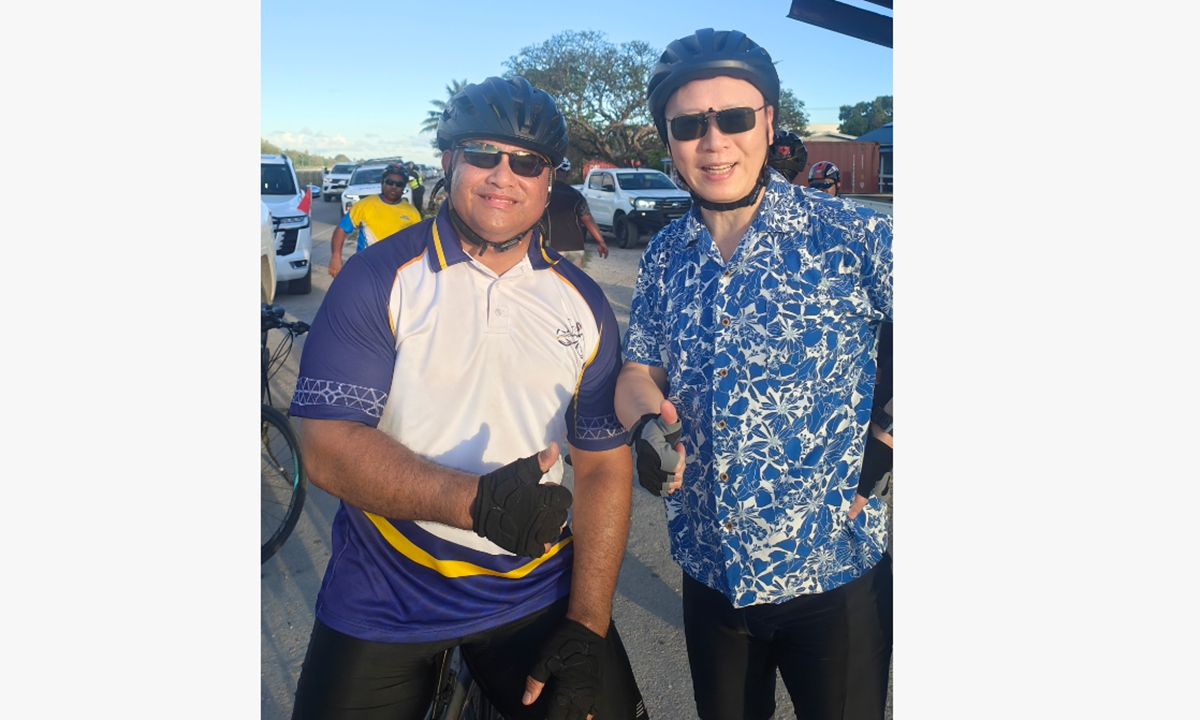
The event offers an unusual glimpse into the close ties between China and the Pacific island country, the Chinese Embassy in Naoero told the Global Times in an exclusive interview, providing further details about the event and the broader cooperation between the two countries.
According to the embassy, Naoero's government has organized various public fitness activities in preparation for hosting the 2028 Micronesian Games, with the aim of improving public health. Whenever his schedule permits, Lü leads embassy diplomats in government-organized cycling events and fitness walks.
The embassy said the cycling route passed several China-supported projects, reflecting the expansion of practical cooperation since China and Naoero resumed diplomatic relations more than two years ago.
Solar-powered streetlights built with assistance from Jiangmen, South China's Guangdong Province, stand along both sides of the road. At Aiwo Port, where a terminal was constructed by China Harbour Engineering Co, a cargo ship provided by China to Naoero was unloading supplies critical to the island.
The Naoero Medical Centre has hosted free clinics provided by ophthalmologists from Sun Yat-sen University, doctors from Xi'an Hospital of Traditional Chinese Medicine and medical personnel from the Chinese PLA Navy hospital ship Silk Road Ark.
A China-aided sports center is also under construction in Naoero's inland highlands. Meanwhile, a hydroponic facility is supplying locally grown lettuce and Chinese cabbage to Naoero's households, helping diversify local dining tables.
As a partner in the Belt and Road Initiative (BRI), China supports Naoero in independently pursuing a development path suited to its national conditions, the embassy said. China has also expanded practical cooperation with Naoero in trade, investment and infrastructure, and provided assistance without political conditions to support the country's independent and sustainable development.
Over the past two years, policy coordination between the two countries has deepened, infrastructure connectivity has advanced, trade has gained momentum, financing channels have expanded and people-to-people exchanges have produced tangible results, according to the Chinese embassy.
The embassy also emphasized Naoero's firm adherence to the one-China principle. Naoero has repeatedly reaffirmed its support for the principle, while its Cabinet recently adopted a resolution requiring public officials to uphold and implement it, with strict rules governing their conduct related to the Taiwan region.
Chinese internet users also noted that Adeang and Lü visited a shop operated by overseas Chinese to buy cold drinks after completing the cycling event.
The embassy said shops operated by overseas Chinese account for more than 90 percent of Naoero's retail market and can be found across the island.
Overseas Chinese began arriving in Naoero more than a century ago and have since developed close ties with local communities. Adeang's maternal family traces its roots to migrants from Guangdong who moved to the South Seas in the 19th century.
In July 2025, Adeang traveled with his family to Jiangmen to trace his roots and pay respects to his ancestors, an event that further strengthened the historical and people-to-people connections between China and Naoero.
。
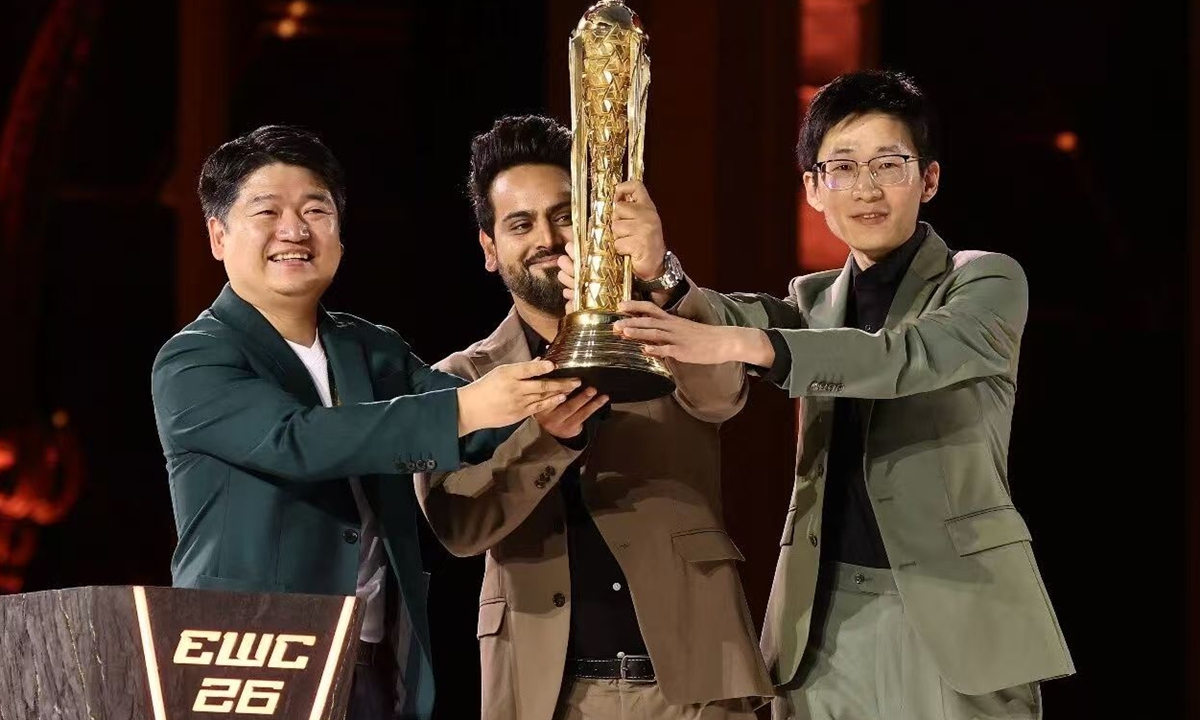
AG.AL's victory was not decided until the final stage of the competition. In the last event, Trackmania, French player Gwen held his nerve under pressure to claim the title, helping AG.AL overtake Saudi Arabian club Team Falcons in the standings and secure the overall championship.
This victory reflects a new trend in global esports competition: competition among top clubs is no longer determined solely by one popular game or a single star player, but by a club's overall capabilities in multi-title strategy, talent development and global operations.
For AG, the title was not just a last-minute breakthrough, but the result of a global strategy that had been developed over years.
"Although the tournament itself lasted only around two months, we had been preparing for it for more than two years," Chen Longsheng (EDDY), AG.AL VP&COO, told the Global Times on Monday. He said AG began expanding its overseas esports operations around the EWC in 2024, selecting promising players from around the world and now covering more than 20 esports titles.
This multi-title strategy is also closely linked to EWC's unique competition format. Unlike traditional esports tournaments that often focus on a single major game, EWC adopts a club-based ranking system covering multiple titles, including Honor of Kings, CrossFire, and Trackmania. AG.AL competed in more than 10 events, accumulating points across different competitions before completing its comeback in the final stage, according to AG.
Chen said the format has also changed how clubs evaluate the value of different esports titles.
"From our perspective, there is no absolute distinction between major and minor titles. As long as players in a game have the ability and passion, they can help the club earn valuable points," he said.
He noted that titles such as Tekken and Trackmania may have smaller audiences compared with some mainstream esports games, but outstanding players in these fields can still become important contributors to a club's championship ambitions because they offer the same opportunity to earn crucial points.
Under this new competitive environment, esports clubs are also shifting from building teams around a single title toward developing more diverse talent systems.
However, for an esports club competing on the global stage, finding the right players is only the first step. Building a stable team among players from different countries and regions, while ensuring smooth operations at international tournaments, also tests a club's management capabilities.
"Cross-border operations involve challenges including language communication, contract arrangements, legal regulations, and player support," Chen said. "Different countries have different legal environments and salary systems, and coordinating all of these issues is actually very complicated."
According to AG, during this year's EWC, staff members followed the teams throughout the process, from players' arrival in Paris, to training arrangements, communication with tournament organizers, post-match interviews and their departure.
"Fans see the players on stage, but behind them there are many operations staff ensuring that the entire team runs smoothly," Chen said.
AG's own development journey also reflects the changes that have taken place in China's esports industry over the past two decades.
In 2001, AG's predecessor won the StarCraft title at the World Cyber Games (WCG) Grand Finals, earning China's first world-level esports gold medal. Twenty-five years later, AG once again reached the top of an international competition. But the way esports is contested has changed dramatically - from battles centered around individual games to competition among global clubs based on talent, operations, and broader ecosystems.
"Over the past two decades, Chinese esports have gradually moved beyond the era when success depended mainly on individual players or a single game title, and developed into a more mature ecosystem involving clubs, professional leagues, content creation, commercial partnerships, and international exchanges," Shanghai-based esports commentator Natto told the Global Times on Monday.
According to Natto, the growing international presence of Chinese esports clubs also reflects a broader change in how the industry views overseas markets.
"Going global is not only about sending teams abroad to compete," Natto said. "It also means understanding different audiences, building communication channels and allowing more people to see the diversity of Chinese esports."
。
Current article:http://ys74c.taokenlaichunlei.bond/710jkz/20260826/4458.html
Published on:17:44:48